
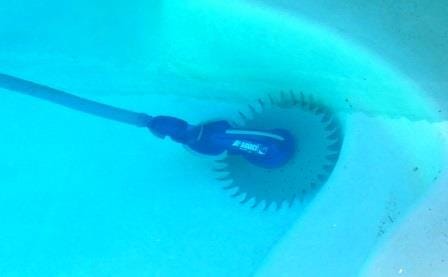
 A suction-side automatic pool cleaner connects to your skimmer port, runs on your existing pump cycle, and vacuums the pool floor without electricity, booster pumps, or a professional pool service visit. I’ve been running a Pentair Kreepy Krauly Kruiser on my 22,000-gallon in-ground pool in Arizona for over 7 years, and I’ve also tested a budget Goplus suction cleaner side-by-side.
The Kreepy Krauly outlasts cheap alternatives by 3–5 seasons, but the setup details and hose calibration make or break whether it actually cleans the whole pool — or just loops the same three-foot circle near the skimmer.
Before you call a professional pool service to vacuum your pool every week, understand that a $150–$250 suction cleaner does the same job for a one-time purchase. The convenience of paying someone $80–$150 per month to vacuum adds up to $960–$1,800 per year. A Kreepy Krauly Kruiser pays for itself in the first 6–8 weeks of ownership.
Evaluate Suction, Pressure, and Robotic Pool Cleaner Types
The DIY approach requires understanding the three categories of automatic pool cleaners before committing to a purchase. Each type has different power requirements, price points, and cleaning strengths. Suction-side cleaners like the Kreepy Krauly are the most popular for budget-conscious residential swimming pool maintenance because they use your existing pump — no additional hardware, no dedicated electrical line, no booster pump.
| Cleaner Type | Unit Cost | Power Source | Cord/Hose Length | Best For | Ongoing Cost |
|---|---|---|---|---|---|
| Suction-side (Kreepy Krauly, Baracuda G3) | $130–$300 | Pool pump suction (0 watts added) | 28–40 ft hose sections | Budget DIY pools with a healthy pump and filter | $15–$40/yr (hoses, seals) |
| Pressure-side (Polaris 280/380) | $350–$600 | Booster pump (150–250W) | 28–36 ft hose | Pools with heavy leaf load and a dedicated pressure line | $30–$80/yr (bags, hoses, booster pump energy) |
| Robotic (Dolphin, Polaris Sport) | $500–$1,500 | 120V outlet (120–200W) | 50–60 ft cord | Owners prioritizing wall scrubbing and fine-particle pickup | $20–$60/yr (filter cartridges, electricity) |
Suction cleaners dominate the under-$300 price range. They have no motors of their own — just a diaphragm or turbine driven by the water flow your pump already creates. That simplicity means fewer parts to break and zero added electricity cost. The trade-off is that they depend entirely on your pump’s suction strength, so a weak pump or clogged filter kills their performance.
Set Up a Kreepy Krauly Kruiser for Complete Pool Coverage
Most complaints about suction cleaners stem from setup mistakes, not product defects. I’ve learned this the hard way over seven years of running suction cleaners in Arizona, where dust, algae, and monsoon debris never stop. The Kreepy Krauly Kruiser needs three things dialed in perfectly before it will clean your entire pool floor.
| Setup Parameter | Target | Failure Symptom |
|---|---|---|
| Hose length | Enough sections to reach the farthest wall + 2 extra sections for climb allowance | Dead zones in far corners; cleaner reverses before reaching the deep end |
| Pump suction (flow rate) | Stable prime, no air leaks at lid or unions | Cleaner stalls mid-floor, loses wall traction, or floats to the surface |
| Skimmer basket | Clean and unobstructed before each run | Reduced suction; the cleaner barely moves or gets stuck on the drain cover |
| Filter condition | Backwashed (sand) or rinsed (cartridge) within the last 7 days | High back-pressure reduces flow to the cleaner by 20–40% |
| Hose float placement | One float 6 inches from the cleaner head, one at the midpoint | Hose sinks and tangles, dragging the cleaner off its random pattern |
| Runtime window | Normal pump cycle + 2–4 hours additional sweep time | Incomplete coverage; cleaner finishes less than 60% of the floor area |
Here’s the part that took me a full summer to figure out: hose length matters more than anything else. Pentair ships the Kruiser with a set of hose sections, but depending on your pool dimensions, you might need 2–3 additional sections. Measure from your skimmer to the farthest corner of the pool, add two more sections, and that’s your target. A short hose means the cleaner reverses in the middle of the pool and loops back over the same clean area, while the far end stays dirty.
The second most common mistake is running the cleaner with a dirty sand filter that hasn’t been backwashed in weeks. A clogged filter creates back-pressure that chokes suction by 20–40%. I backwash mine every 5–7 days during the Thermal Sanitization Stress Period when Arizona dust and algae spores are at their peak.
Compare the Kreepy Krauly Kruiser Against Budget Alternatives
I bought a Goplus suction cleaner on Amazon for $79 after my Kreepy Krauly hose sections started leaking due to UV damage. My logic was simple — new hoses alone cost $60–$80, so for $20 more, I’d get a complete backup cleaner with fresh hoses included. The Goplus worked for about 14 months before the diaphragm cracked and the body seams started leaking suction.
| Model | Street Price | Hose Sections Included | Diaphragm Life (observed) | Wall Climb | Build Quality |
|---|---|---|---|---|---|
| Pentair Kreepy Krauly Kruiser | $180–$250 | 12 (32 ft total) | 3–5 years | Moderate (waterline on good suction) | Thick plastic, UV-resistant body |
| Pentair Kreepy Krauly Classic | $250–$320 | 14 (36 ft total) | 4–6 years | Strong (climbs walls reliably) | Heavy-duty, proven 20+ year design |
| Baracuda G3 (Zodiac) | $200–$280 | 12 (32 ft total) | 2–4 years | Moderate | Compact design, finesse-drive navigation |
| Goplus / Generic suction cleaner | $70–$100 | 10 (26 ft total) | 8–18 months | Weak (floor only) | Thin plastic, UV cracks within 1–2 seasons |
The Kreepy Krauly Kruiser costs roughly 2x as much as the Goplus, but it lasts 3–5x longer. Over a 5-year window, the Kruiser costs $0.10–$0.14 per day of cleaning. The Goplus costs about $0.15–$0.35 per day once you factor in replacing the unit every 12–18 months. The most cost-effective remediation is buying the Kruiser once and replacing just the hose sections and pleated seal every 2–3 years — total annual maintenance runs $15–$40.
I still keep a budget suction cleaner as a backup for monsoon season when debris loads are extreme, and I don’t want to punish my primary Kreepy Krauly. Having a $79 backup that I can sacrifice in heavy-debris conditions has actually saved me from wearing out my Kruiser prematurely.
Troubleshoot Kreepy Krauly Performance Problems
Every suction cleaner eventually acts up. I’ve had my Kruiser stall, loop in circles, lose wall traction, and sit motionless on the pool floor at various points over the past seven years. Every single time, the problem traced back to one of five causes — and none of them required a repair technician.
| Symptom | Likely Cause | Fix | Time to Repair |
|---|---|---|---|
| Cleaner not moving at all | Air leak at pump lid, clogged skimmer basket, or pump losing prime | Check the lid O-ring, clean the basket, and verify the prime holds for 30 seconds | 5–15 min |
| Loops the same small area repeatedly | Hose too short or hose float missing/misplaced | Add 2–3 hose sections; reposition floats (one near head, one at midpoint) | 10 min |
| Loses suction on walls and steps | Worn pleated seal (diaphragm flapper) | Replace the pleated seal — $8–$15 part on Amazon | 15 min |
| Flips upside down or tangles | The hose floats too far from the head, or the hose kinks from heat warping | Move float to 6 inches from head; straighten hose in the sun for 30 min | 5 min |
| Stalls in the deep end | Filter back-pressure too high (dirty filter reduces flow 20–40%) | Backwash sand filter or rinse cartridge filter | 10–20 min |
The most common fix I perform is replacing the pleated seal. It’s a $10 rubber disc that creates the suction seal against the pool surface. After 2–3 years of UV exposure and chemical contact, it warps and cracks. When my Kreepy Krauly stopped climbing the walls last summer, I assumed the pump was failing — I spent an hour fixing pool equipment and maintenance problems before realizing the seal was the problem. A $10 part and 15 minutes fixed it completely.
Maintain Your Suction cleaner Through Summer Heat
Arizona pool owners deal with the Thermal Sanitization Stress Period from May through September, when surface temperatures hit 90°F+ and algae spore counts explode. Running a suction cleaner during peak heat requires extra attention to both the cleaner and the pool filter system it depends on.
To rebalance the water chemistries during heavy cleaner use, I increase my pump runtime by 2 hours and backwash the sand filter twice per week instead of once. The cleaner pulls debris off the floor and pushes it through the filter — if that filter is already 80% loaded, suction drops and the cleaner stalls. I also pull the cleaner out of the water when it’s not running. Leaving it submerged 24/7 accelerates UV degradation on the hose sections and fades the body plastic, especially in direct Arizona sun.
The complete pool cleaning maintenance routine I follow runs the suction cleaner 4–6 hours daily during summer, then I pull it out, coil the hose in the shade, and let the pump finish its normal filtration cycle. This approach has kept one set of Kreepy Krauly hoses alive for 3+ years when the manufacturer estimates 2.
Watch how a Kreepy Krauly works.
Calculate the True Cost of Automatic Pool Vacuuming
Pool owners overthink the purchase price and ignore the 5-year cost of ownership. A suction cleaner’s real costs include replacement parts, energy use (which is zero for suction models since they use your existing pump), and the number of seasons the unit lasts before you buy another one.
| Cost Factor | Kreepy Krauly Kruiser | Goplus / Budget Suction | Robotic (Mid-Range) | Professional Service |
|---|---|---|---|---|
| Initial purchase | $200 | $85 | $800 | $0 |
| Annual parts/maintenance | $25 | $85 (replacement unit) | $40 | $0 |
| Annual energy added | $0 | $0 | $35–$60 | $0 |
| Annual service cost | $0 | $0 | $0 | $960–$1,800 |
| 5-year total | $325 | $510 | $1,175 | $4,800–$9,000 |
The Kreepy Krauly Kruiser wins the 5-year cost comparison against every category. Budget cleaners look cheap up front, but replacing them every 12–18 months adds up. Robotic cleaners deliver superior wall cleaning and fine-particle pickup, but they cost 4x as much over the same period. And paying a professional pool service? That’s a minimum of $4,800 over five years for a task that a $200 suction cleaner handles automatically while you sleep.
Stock Replacement Parts and Accessories
Keeping two or three spare parts on hand prevents downtime when something wears out mid-season. I order these from Amazon and keep them in my pool shed so I’m never stuck waiting for a delivery while my pool floor turns green.
- Pleated seal (diaphragm): $8–$15. Replace every 2–3 years or when wall climbing stops. This is the single most common replacement part.
- Hose sections (pack of 4): $25–$40. Replace cracked or UV-damaged sections. Buy the same diameter as your original Pentair hoses to ensure airtight connections.
- Hose floats: $5–$8 each. These crack and sink after 2 seasons of sun exposure. Keep two extras.
- Foot pads/shoes: $10–$15. The rubber feet that grip the pool floor wear down over time, especially on textured plaster surfaces.
- Skimmer cone adapter: $12–$18. Connects the hose to your skimmer. The original will last for years, but if yours cracks from UV exposure, the cleaner loses 100% of its suction.
The total annual spare parts cost runs $15–$40, depending on what needs to be replaced. Compare that to the full cost of buying pool supplies for a season — the suction cleaner maintenance is one of the cheapest line items in your entire pool budget.
The essential swimming pool tools for beginners list should include a suction cleaner, along with your brush, skimmer net, and test kit. A skimmer nets and surface cleaning handles surface debris, while the suction cleaner takes care of everything that sinks to the bottom — together, they eliminate 90% of manual vacuuming.
Where To Get A Kreepy Krauly Pool Cleaner

- Suction side pool cleaner
- Superior suction
- Wider mouth for large and small debris
- Easy installation
- One moving part for less maintenance

- 3 SIMPLE STEPS: In just three simple steps, the G3 cleaner is ready to clean your pool. Simply attach the disc, wheel deflector, and hose, and connect to the skimmer or dedicated suction line.
- FOR IN-GROUND POOLS:Compatible with low flow and variable speed pumps the G3 safely cleans multiple in ground pool surfaces including tile, vinyl, gunite, and fiberglass
- MANEUVERABILITY: The wheel deflector enables enhanced agility for negotiating tight corners in your in ground pool
- SMOOTH USE: The 36-Fin Disc ensures maximum adhesion on surfaces of all pools, and eliminates hang-ups on lights, drain covers and fittings
- WHAT'S INCLUDED: G3 Suction Pool Cleaner, 39' Push-Fit Feed Hose
Automatic Pool Cleaner Alternatives
![[2026 NEW] C1 Robotic Pool Cleaner with 180Mins, Deep Gray](https://www.poolserviceall.com/wp-content/plugins/aawp/public/image.php?url=YUhSMGNITTZMeTl0TG0xbFpHbGhMV0Z0WVhwdmJpNWpiMjB2YVcxaFoyVnpMMGt2TkRGa2RFMUtkR3hZWWt3dVgxTk1NVFl3WHk1cWNHYz18MTc5MTMzNDgzMA=)
- Wall-Climbing & 7 Cleaning Modes: This cordless pool cleaner features premium wall-climbing and waterline cleaning functions, acting as an all-round efficient pool vacuum. Equipped with 7 customizable cleaning modes and paths, this pool robot cleans pool floors, walls and waterlines, perfectly solving the trouble of manual residual stain cleaning for in-ground pools.
- Triple Motors & Dual Filtration System: Powered by upgraded triple motors and dual rolling brushes, this cordless pool cleaner delivers strong and stable cleaning power. Paired with a dual-layer filtration system, this high-performance pool vacuum effectively traps fine dirt, leaves and sediment, keeping your pool water crystal clear and greatly reducing manual cleaning work.
- Fast Charging & 180Mins Long Battery Life: Designed for in-ground pool households, this smart pool robot supports fast 2.5-hour full charging and long-lasting battery life. It perfectly fits large in-ground pools up to 1615 sq.ft, realizing full-coverage automatic cleaning, no frequent recharging needed, ideal for daily and periodic pool maintenance.
- Smart APP Control: This multifunctional cordless pool cleaner supports professional APP control, bringing a hands-free cleaning experience. You can easily switch cleaning modes and customize cleaning paths via your phone. This smart pool vacuum simplifies pool maintenance and saves your precious leisure time efficiently. Note: set before entering the water.
- All-in-One Cordless Pool Cleaning: This all-in-one pool robot integrates wall-climbing cleaning, deep filtration, long endurance and intelligent APP control, perfectly matching the needs of family users with in-ground pools. Cordless and fully automatic design avoids cumbersome wire arrangement, being a practical and essential upgrade tool for home pool cleaning.

- 💪 5,500 GPH Super Suction + Triple‑Action Cleaning – Dual drive motors, a dedicated pump, and two active brushes work together to power through leaves, sand, and fine debris. The 4L filter basket with 150μm mesh traps particles effectively, so your pool stays noticeably clearer with less floating dirt.
- 🏊 Full‑Pool Coverage – Floor, Wall & Waterline – Choose from Full Pool, Floor Only, or Wall Only modes to target exactly what needs cleaning. The robot scrubs the floor, climbs walls, and works along the waterline to deliver complete routine maintenance – reducing your manual brushing time significantly.
- 🧠 Smart S‑ & N‑Path Navigation – Instead of wandering randomly, this cleaner follows an S‑shaped route on the floor and an N‑shaped pattern on walls to minimize overlap and missed spots. High‑grip tracks handle transitions and slopes up to 30° with ease, so it won’t get stuck or slip.
- 🔋 Up to 120 Minutes Cordless Runtime – The built‑in 5200mAh battery powers pools up to 1,830 sq. ft. on a single charge, and recharges in about 2.5 hours. No cords, no external pump – just drop it in and let it run, whether you have an inground or compatible above‑ground pool.
- 🅿️ Self‑Parking & Easy‑Clean Filter – When the cycle finishes or battery runs low, the unit automatically parks near the edge for easy retrieval using the included hook. Simply lift out the top‑loading filter basket and rinse it with a garden hose – quick, tidy, and ready for the next clean.

- Easy to Set Up and Efficient Cleanning and Super Quietly - Our pool vacuum cleaner isvery easy to assemble & install & allows you to clean your pool effortlessly andquietly, unlike some other automatic pool cleaners that make an annoying hammernoise. Low noise, create a quiet operate environment
- Save Your Time, Make Your Life Easier - Xtremepowerus pool vacuum provide a quick and easy way to clean your swimming pool, No jamming or breaking interrupting the cleaningprocess. lt keeps the pool clean, & it will cut down a lot on your time spent cleaningthe pool
- Great Suction Power & Can't Stuck - This automatic pool cleaner for in-ground pools thoroughly cleans swimming pools including the walls! Our pool vacuum canefficiently remove dirt, debris. Wheel Deflector for movement around tight corners. Scuff-resistant hoses eliminate scuffs on all pool surfaces.
- Can be used on many different sizes, shapes, or construction (Excluding stairs); Vacuum pools regardless of size, shape, or construction; Attaches to your existing filtration system. For optimal performance, this automatic wall-climbing cleaner requires a pool pump with minimum 1HP power or flow rate of 1600gal/h. Adjust the weights and regulator valve as needed to achieve maximum cleaning efficiency
- Include 30ft Hoses Set - Our swimming pool vacuum come with (10) premium durable suction hoses. You can attaches this pool sweeper to your existing filtration system. The caliber of the pipe is 1.5''. Just put it inside your pool and it will automatically start cleaning your pool from top to bottom without wasting time and effort

- WALL-SCRUBBING POWER: Dolphin Nautilus CC climbs walls efficiently, ensuring thorough cleaning on any pool surface, no matter the shape or surface type.
- ACTIVE SCRUBBING: Elevate your pool maintenance with the Dolphin Nautilus CC - active scrubbing brush eliminates manual effort, guaranteeing a pristine pool. Gentle on surfaces, tough on debris.
- EASY FILTER CARE: Effortlessly maintain a clear pool with our user-friendly top-load filter basket. Easily remove debris for crystal-clear water, enhancing your swimming experience.
- PLUG-AND-PLAY EFFICIENCY: Make pool cleaning a breeze with our simple plug-and-play system. Just plug in, drop into the pool, and power on for a spotless pool in 2 hours.
- THE DOLPHIN LEGACY: Over 40 years of effortless cleaning with unmatched performance, durability, and cost savings. Enjoy your pool, hassle-free!

- Note:The vacuum requires at least a 3/4hp swimming pool pump or 1600ghp to function properly.
- Easy to Set Up and Efficient Cleanning and Super Quietly. This pool vacuum cleaner isvery easy to assemble and install and allows you to clean your pool effortlessly andquietly, unlike some other automatic pool cleaners that make an annoying hammernoise. Low noise, create a quiet operate environment.
- Great Suction Power and Can't Stuck, This automatic pool cleaner for in-ground pools thoroughly cleans swimming pools including the walls! This pool vacuum canefficiently remove dirt, debris. Wheel Deflector for movement around tight corners.Scuff-resistant Long-Life Hoses eliminate scuffs on all pool surfaces.
- Save Your Time, Make Your Life Easier. Our pool vacuum provide a quick and easy wayto clean your swimming pool, No jamming or breaking interrupting the cleaningprocess. lt keeps the pool clean, and it will cut down a lot on your time spent cleaningthe pool.
- Worry-Free Guarantee . One year warranty, if any part of this item broken you cancontact us for a free replacement,We go above and beyond to provide the highestquality product. lf you have any questions or concerns about your order,please keep intouch with us, we'll always provide you a timely and satisfying solution.
Frequently Asked Questions About Kreepy Krauly Pool Cleaners
How does a Kreepy Krauly work?
A Kreepy Krauly uses your pool pump’s suction to create a vacuum at the cleaner head. A flexible diaphragm (pleated seal) pulses against the pool surface, creating a rocking motion that propels the unit in a random pattern across the floor. Water and debris are pulled through the hose into your skimmer basket, then through the filter. No electricity, motor, or booster pump is required — the cleaner runs entirely on the hydraulic energy your pump already produces during its normal filtration cycle.
How long does a Kreepy Krauly Kruiser last?
The body lasts 5–7 years with proper care. The pleated seal needs replacement every 2–3 years ($8–$15), and hose sections typically survive 3–4 years before UV damage causes cracks. Pulling the cleaner out of the water between runs and storing the hoses in the shade significantly extends lifespan — I’ve gotten 7 years from my Kruiser body with this approach.
Is the Kreepy Krauly Kruiser good for inground pools?
The Kruiser is designed specifically for in-ground pools up to 20,000–25,000 gallons. For larger pools, add extra hose sections to ensure the cleaner reaches every corner. It handles plaster, pebble, vinyl, and fiberglass surfaces. Above-ground pool owners should look at the Kreepy Krauly models specifically rated for above-ground use, as the hose connections and suction requirements differ.
Why is my Kreepy Krauly not moving?
Check three things in order: (1) skimmer basket — a clogged basket cuts suction immediately; (2) pump prime — air leaks at the pump lid O-ring or suction-side unions cause the cleaner to stall; (3) filter pressure — a dirty filter creates back-pressure that reduces flow to the cleaner by 20–40%. If all three check out, inspect the pleated seal for cracks or warping.
What is the difference between the Kreepy Krauly Kruiser and the Classic?
The Classic costs $70–$100 more, weighs slightly more, and uses a stronger suction design that climbs walls more reliably. The Kruiser is lighter and better suited for floor-only cleaning at a lower price point. For pools with steps, ledges, and benches that trap debris, the Classic justifies the premium. For flat-bottom pools where floor coverage is the priority, the Kruiser delivers 90% of the performance at 60% of the cost.
How does the Kreepy Krauly compare to the Baracuda G3?
The Baracuda G3 (made by Zodiac) uses a “finesse” drive mechanism instead of a diaphragm pulse. It navigates more smoothly and quietly, but the drive mechanism has more moving parts that wear faster. In my experience, Kreepy Krauly diaphragms outlast G3 internal components by 1–2 years. The G3 typically costs $200–$280 and performs similarly to the Kruiser on flat surfaces. Choose the G3 if noise matters to you; choose the Kruiser if you want the longest part life and lowest maintenance cost.
Can I use a suction cleaner to vacuum dead algae?
A suction cleaner can pick up settled algae dust, but the fine particles may pass through a sand filter and return to the pool. The most cost-effective remediation is vacuuming to waste (bypassing the filter) for heavy algae loads, then running the suction cleaner for daily maintenance once the water clears. After a major algaecide treatment, give the dead algae 24 hours to settle before running the cleaner — this prevents stirred particles from being re-suspended before the filter can trap them.
Is a suction pool cleaner worth it for DIY pool owners?
A suction cleaner is the single best return-on-investment tool for residential swimming pool maintenance. At $150–$250 for a quality unit like the Kreepy Krauly, it eliminates 4–6 hours per week of manual vacuuming and pays for itself within 2 months, versus hiring a professional pool service. Pair it with a weekly pool chemical testing routine, and you have 90% of what a paid service does for a fraction of the cost.
I’m in need of some help and thought why not ask.
I live in small town usa in the middle of no where in illinois.
I have a 27ft x 5ft above ground pool that we installed ourselves 5 years ago. Pool was not too much to care for the first couple of years but last year and this year I have an ever going problem and have no idea how to fix it.
Last year shortly after opening the pool we noticed a small amount of fine powdery tannish colored substance in the bottom of our pool. Did some research on google and thought it was mustard algae so I treated it accordingly and threw away everything and started new. Didn’t help still there. So I Called the local pool store. Their suggestion bring in a water sample and so it began. Sample was tested came back as nothing pretty much. Told me it couldn’t be algae the chlorine was too high for algae. Told me I possibly had a cracked lateral. We replaced all the laterals in our tank and replaced all the sand. Didn’t work, still there. Had the water tested multiple more times with still no indication of what it was. Finally the pool store told me it must be dust from the field behind us as they had been having the same problem at there lot and had a technician dive check it and it was dust from the road. I didn’t think so as the field has always been there and the problem hadn’t but I’m not the pool expert. This continued all year until we closed. This year we opened the pool, it has been record level flooding and extremely wet here in central Illinois. Opened the pool and again we have the problem. Treat for algae again and still it remains. I should mention when I treat for the algae I tripled the amount of shock and did this three times in 24 hours then vacuumed to waste and back washed the filter. We opened our filter and found some very unattractive deposits on top of the sand, so we removed several inches of sand and for a day or two things slowed way down and barely had anything in the pool but to no avail it started again. My husband thought maybe since it slowed down when we removed the top part of the sand that I hadn’t back washed enough and destroyed the sand so we Removed, cleaned the tank and replaced all sand and still it is there. This is a powdery substance, it isn’t stuck to the liner, isn’t slimy and if you try to touch it it kinda dissipated into a cloud and is gone, there is no grit to it to make me think its sand and this never happens until you turn on the pump. If you leave the pump off it doesn’t go into the pool but as we know you have to pump and filter or you basically have a cesspool of lord knows what. I called the pool store closest to where we live to ask for them to send a technician as soon as I opened this year and found it still there but we are in the middle of nowhere and I was told they would call me back with a time and they never called back and when i call now they tell me I’m too far out of their service district but that they had the same issue last year its just dust . I don’t know what else to do except drive a truck through my pool which I enjoy (when it isn’t giving me migraines lol) very much.
Any helpful tips you have I would be open to hearing.
Lost in dust?
Nellie
Hi Nellie,
Being in Arizona I’m not sure if we are dealing with the same issue but I had a very thin film of soot that I could not get rid of until I bought a Kreepy Krauly. Basically, very fine particles of crud and pollution were coming from the air around my house and were settling in my pool. Running the automatic pool cleaner daily and backwashing weekly took care of the problem.
Hope this help you?
Thanks,
Joe