
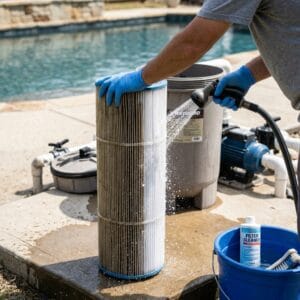
 Your pool filter does more work than any other piece of equipment on your pad. The pump moves the water, the chlorine kills the bacteria, but the filter is what actually removes the physical debris — dead algae, body oils, sunscreen, dust, and the fine particles that turn clear water cloudy.
I’ve maintained cartridge filters in my Arizona pool for over a decade, and the single biggest improvement I ever made to my water clarity was learning how to properly clean and schedule my filter maintenance, rather than waiting until the water looked bad.
This guide covers all three residential filter types — cartridge, sand, and DE — with the specs, cleaning procedures, replacement timelines, and troubleshooting steps that apply to each.
Whether you’re a new pool owner figuring out what’s inside that big tank on your equipment pad or a veteran DIYer trying to squeeze another season out of aging cartridges, the information here will help you make better decisions about the single most important component for water clarity.
Understand How Pool Filtration Actually Works
Every pool filter operates on the same basic principle: water is pushed through a medium (fabric, sand, or powder) that traps particles too small for the skimmer basket to catch. Clean water returns to the pool through the return jets. As the medium collects more debris, flow resistance increases — that’s what your pressure gauge measures. When resistance gets too high, filtration drops off, and the pump works harder for less result.
The filter sits between the pump and the return lines. Water flows from the pool through the skimmer and main drain, into the pump, out of the pump at pressure, through the filter medium, and back into the pool. Every component in that path matters, but the filter is where clarity is made or lost. A $2,000 variable-speed pump pushing water through a neglected filter produces worse results than a $400 single-speed pump with a clean filter.
Compare the Three Residential Filter Types
Your pool has one of three filter types. Each catches particles down to a different size (measured in microns — a human hair is about 70 microns wide), uses different media, and requires different maintenance. Knowing which one you have determines your entire cleaning and replacement schedule.
| Attribute | Cartridge Filter | Sand Filter | DE (Diatomaceous Earth) Filter |
|---|---|---|---|
| Filtration level | 10–15 microns | 20–40 microns | 2–5 microns |
| Filter media | Polyester pleated fabric cartridges | Pool-grade silica sand (#20, 0.45–0.55 mm) | DE powder coated onto internal grids |
| Cleaning method | Remove cartridges, hose off, soak in degreaser | Backwash (reverse water flow for 2–3 min) | Backwash + recharge with fresh DE powder |
| Water waste per cleaning | ~5 gallons (hose rinse only) | 200–500 gallons per backwash | 200–500 gallons per backwash + DE disposal |
| Media replacement cycle | Every 2–3 years (fabric degrades) | Every 5–7 years (sand compacts and channels) | Grids last 5–10 years; DE powder replaced every backwash |
| Typical residential tank size | 100–525 sq ft of filter area | 19–24 inch diameter tank | 24–60 sq ft of grid area |
| Flow rate capacity | 25–150 GPM depending on size | 30–60 GPM (standard residential) | 30–72 GPM depending on grid area |
| Best for | Most residential pools; water-conservation areas | Pools with heavy debris loads; low-maintenance owners | Pools where crystal clarity is the top priority |
| Equipment cost (replacement) | $60–$200 per set of cartridges | $30–$60 for 50 lbs of filter sand | $150–$350 for full grid assembly; $15–$25 for DE powder |
Cartridge filters dominate modern residential pools because they waste almost no water during cleaning and provide solid 10–15 micron filtration. Sand filters are the simplest to maintain — just flip a valve and backwash — but they let finer particles pass through. DE filters produce the clearest water of all three types (2–5 microns catches particles invisible to the eye) but require the most hands-on maintenance. No type is objectively “better” — the right choice depends on your water source, debris load, and how much cleaning time you’re willing to invest.
Monitor Your Pressure Gauge to Time Every Cleaning
The pressure gauge on top of your filter tank is the single most important diagnostic tool on your equipment pad. It tells you exactly when your filter needs attention — no guessing, no calendar reminders, just a dial with a number.
| Pressure Reading | What It Means | Action Required |
|---|---|---|
| Clean baseline (note this after every cleaning) | Filter media is clean, and flow is unrestricted | None — write this number on tape on the tank |
| 3–5 PSI above baseline | Normal debris accumulation, filter is working | None — filter is performing at peak efficiency |
| 8–10 PSI above baseline | Media is saturated — flow is restricted, pump is straining | Clean cartridges, backwash sand/DE immediately |
| 12+ PSI above baseline | Overdue cleaning — risk of pump damage, cloudy water, heater shutdown | Stop pump, clean filter, inspect for media damage |
| 0 PSI (pump running) | Broken gauge or major suction leak | Replace gauge ($8–$12) or check pump lid O-ring for air leak |
| Below baseline after cleaning | Possible broken internal (cracked lateral, torn cartridge, damaged grid) | Inspect filter internals — debris may be bypassing the media |
I write my clean baseline on a piece of tape stuck to the filter tank — mine reads 12 PSI with a clean cartridge set. When the gauge hits 20–22 PSI, I know it’s time to pull the cartridges without even looking at the water. This method removes all guesswork. If your gauge reads 8–10 PSI above baseline and you ignore it, the pump motor works harder, electricity costs go up, and the heater may shut down from low flow. Before you call a professional to diagnose cloudy water or a heater that won’t fire, check the filter pressure first — more than half the time, a dirty filter is the entire problem.
Clean Each Filter Type the Right Way
Cleaning method varies by filter type, but one rule applies to all three: always release the air pressure from the tank before opening it. Open the air relief valve on top of the tank, wait for the gauge to read zero, and listen for the hissing to stop completely. Filter tanks operate at 10–25 PSI — opening a pressurized tank can launch the lid with enough force to cause serious injury.
Cartridge filter cleaning
Turn off the pump. Release air pressure through the relief valve. Remove the tank clamp or lock ring. Lift out the cartridge elements — most residential filters have 1–4 cartridges. Hose each cartridge from top to bottom with a standard garden hose, working between each pleat to flush out trapped debris. For deep cleaning every 3–4 months, soak the cartridges overnight in a filter degreaser solution ($10–$15 per bottle) to dissolve body oils and sunscreen that hosing alone can’t remove.
The clean swap method saves time: own a second set of cartridges ($60–$200 depending on filter model). When pressure rises, pull the dirty set, drop in the clean spares, and your pool is back to filtering in 10 minutes. Soak and hose the dirty set at your convenience during the week. I’ve used this method for years and it cuts my active maintenance time per cleaning from 45 minutes to about 10.
Sand filter cleaning (backwash)
Turn off the pump. Rotate the multiport valve to the “Backwash” position — never turn this valve with the pump running or you’ll crack the internal diverter. Turn the pump back on and run water out the waste line for 2–3 minutes until the sight glass runs clear. Turn off the pump, switch to “Rinse” for 30 seconds to settle the sand bed, then return to “Filter.” The entire process takes 5 minutes and uses 200–500 gallons of water.
DE filter cleaning
Backwash the same way as a sand filter. After backwashing, you must add fresh DE powder through the skimmer to recoat the grids. Regular pool cleaning ensures peak performance. Dosing is typically 1 lb of DE per 10 sq ft of grid area — check your filter manual for the exact amount. Twice a year, open the tank, pull the grid assembly, and hose each grid clean to remove the accumulated cake of DE and trapped debris that backwashing alone doesn’t fully clear.
Size Your Filter Correctly for Your Pool
An undersized filter clogs faster, strains the pump, and never delivers the water clarity you expect. An oversized filter runs longer between cleanings and produces better results with less effort. When replacing a filter or sizing one for a new installation, match the filter’s flow rate capacity to your pump’s output.
| Pool Volume | Pump Flow Rate | Minimum Cartridge Area | Minimum Sand Tank Diameter | Minimum DE Grid Area |
|---|---|---|---|---|
| 10,000–15,000 gallons | 30–50 GPM | 100–200 sq ft | 19 inches | 24 sq ft |
| 15,000–25,000 gallons | 40–70 GPM | 200–400 sq ft | 22–24 inches | 36–48 sq ft |
| 25,000–40,000 gallons | 60–100 GPM | 300–525 sq ft | 24–30 inches | 48–60 sq ft |
The DIY approach requires matching your pump’s GPM output to the filter’s rated flow capacity — never exceed the filter’s maximum GPM, or water will push through the media too fast for effective particle capture. When in doubt, go one size up. A larger filter costs $50–$100 more upfront but runs longer between cleanings and produces consistently clearer water.
Troubleshoot Common Filter Problems
Most filter problems show up as cloudy water, unusual pressure readings, or debris returning to the pool through the return jets. Here’s what each symptom means and how to fix it without calling a service tech.
| Symptom | Likely Cause | Filter Type | Fix | Cost |
|---|---|---|---|---|
| Cloudy water, high pressure | Saturated media — overdue cleaning | All types | Clean/backwash immediately, soak cartridges in degreaser | $0–$15 |
| Debris returning through jets | Torn cartridge fabric, cracked sand lateral, damaged DE grid | All types | Inspect internals, replace damaged element | $20–$200 depending on part |
| Pressure won’t drop after cleaning | Body oil/sunscreen buildup in media (chemical clog) | Cartridge, sand | Chemical soak (cartridge) or sand replacement | $15 (degreaser) or $30–$60 (sand) |
| Pressure gauge reads 0 with pump on | Broken gauge or suction-side air leak | All types | Replace gauge ($8–$12) or find/fix air leak at pump | $8–$50 |
| Pressure below baseline after cleaning | Bypassed media — debris flowing around the filter element | All types | Inspect cartridge bands, laterals, or grid manifold for cracks | $20–$350 depending on part |
| Short filter cycles (clogs within days) | Algae bloom or undersized filter | All types | Treat algae with shock first, then address filter sizing | $5–$200 |
Before you call a professional for a filter diagnosis, work through the table above. Most filter problems have a $0–$50 fix that takes 15–30 minutes. A service tech charges $75–$150 for a diagnostic visit — and the diagnosis is usually “your filter needs cleaning” or “this cartridge is torn.” The most cost-effective remediation is learning to read your pressure gauge and inspect your own media, because these are the two skills that prevent 90% of filter-related service calls.
Replace Filter Media at the Right Time
Every filter medium has a lifespan. Cleaning extends it, but eventually the media degrades to the point where it can no longer trap particles effectively — and no amount of cleaning brings it back.
- Cartridge replacement (every 2–3 years): Replace when the polyester fabric feels mushy or fuzzy (fibers are breaking down), when the plastic end caps or support bands crack, or when pressure won’t return to baseline after a chemical soak. In Arizona, intense UV and high calcium water degrade cartridges faster than cooler climates. Budget $60–$200 per set depending on brand and filter model. Common replacement brands include Pleatco, Unicel, and Filbur.
- Sand replacement (every 5–7 years): Sand grains erode and compact over time, creating channels that let debris pass through. Signs of worn sand: cloudy water that doesn’t clear with backwashing, sand appearing in the pool near return jets, or inability to drop pressure below baseline. A 50-lb bag of #20 silica filter sand costs $10–$15 — most residential filters need 100–300 lbs.
- DE grid replacement (every 5–10 years): Grids develop tears in the fabric that let DE powder pass through and return to the pool as white powder on the floor. If you see DE powder in the pool after a recharge, at least one grid is torn. Individual grids run $20–$40; a full grid assembly costs $150–$350.
To rebalance the water chemistries after a filter media replacement, run the pump for a full 24-hour cycle with the new media installed, then test FC, pH, and TA. New cartridges and fresh sand can temporarily alter pH readings as manufacturing residues wash out during the first few run cycles.
Maintain Your O-Rings and Tank Hardware
Every time you open the filter tank — for cleaning, inspection, or media replacement — inspect and lubricate the tank O-ring. This rubber seal is the only thing preventing a high-pressure water leak at the tank junction.
- Clean the O-ring: Wipe it with a damp cloth to remove grit, sand, or calcium buildup. Even tiny debris on the O-ring surface can cause a leak under pressure.
- Lubricate with silicone only: Apply a thin coat of silicone-based lubricant (Jack’s Magic #327 or equivalent pool-grade silicone, $6–$10). This keeps the rubber supple and prevents cracking from UV and heat exposure. Never use petroleum-based products (Vaseline, WD-40) — petroleum swells the rubber, destroys the seal, and creates a leak that’s expensive to fix because you’ll need to replace the entire O-ring assembly.
- Check the tank clamp or lock ring: Tighten evenly after reassembly. An unevenly seated clamp causes the lid to shift under pressure, which damages the O-ring and can crack the tank body over time. Replacement clamps run $15–$40.
During the Thermal Sanitization Stress Period, high ambient temperatures accelerate rubber degradation. I replace my filter tank O-ring every 2 years as preventive maintenance — a $10–$15 part that prevents a $100+ leak repair.
Pool Dilter Products
Pool Filter Cartridges

- 🍀Specifications: Length: 26"; Outside Diameter: 7"; Top Opening: 3"; Bottom Opening: 3"; Material Area: 105 Sq.ft; Filter Material: Trilobal Filtration Fabric.
- 🍀Compatible Models: PLF105A Pool Filter compatible Pentair CCP420, 160301, Waterway Crystal Water 425, 570-0425, SD-00163, AK-60431, Aladdin 20503, Filbur FC-6470. ★NOTE: This is a compatible spare part and the manufacturers' names and part numbers have been used for reference purposes only. POOLPURE is an independent brand.
- 🏊 Proud Partner of Florida Gators Swimming & Diving: PoolPure’s official partnership with the Florida Gators reflects our shared commitment to water quality, reliability, and performance. Select orders may include a Gators-branded collectible month marker as a surprise gift. Not included with every purchase.
- 📺Proven by Athletes & Media Tested in real training environments and featuring Olympic swimmer Rhyan White, our filters deliver reliable performance where it matters most—while recognition from NBC Local highlights our commitment to consistent filtration and superior water quality.
- 🍀NSF/ANSI 50 Certified Safety: PoolPure pool and spa filters are tested and certified by IAPMO against NSF/ANSI 50 standards for material safety. All components are proven safe for long-term water exposure, ensuring no harmful substances are released. Trusted by over 5 million pool owners, PoolPure delivers cleaner, safer pool and spa water for your family.

- 【Size】Length: 26"; Outside Diameter: 7"; Top Opening: 3"; Bottom Opening: 3"; Material Area: 105 Sq.ft
- 【Perfect Match】Compatible with Pentair CCP420, 178584, Ultral-A6, Unicel C-7471, 817-0106, R173576, Filbur FC-1977, 570-0425-07, Pentair Clean and Clear Plus 420, ★NOTE: This is a compatible part. Original manufacturers' names and part numbers are for reference only. PureLumi stands as an independent brand.
- 【Powerful Dirt Capture】Made with high-performance filtration media similar to premium industry materials, this filter features a higher fiber density per unit area for enhanced dirt-holding capacity. It efficiently captures common debris such as dust, leaves, and fine particles while maintaining strong water flow, delivering reliable filtration performance with up to 99% particle removal. Fully compatible with saltwater pool systems.
- 【Easy-Rinse Design — Clean in Seconds】Engineered with an optimized point-bonded fiber structure, contaminants are less likely to embed deeply into the media. Most trapped debris can be quickly removed with a simple rinse, making routine maintenance fast, easy, and hassle-free.
- 【Long-Lasting Performance】Reinforced internal support structure helps maintain stable water flow and filtration efficiency even after multiple cleaning cycles, effectively extending service life and reducing replacement frequency. Under proper use and maintenance, it can support 10+ cleaning cycles while still maintaining strong filtration performance.

- 🍀Specifications: Length: Length: 23 1/4"; Outside Diameter: 8 15/16"; Top Bottom Opening: 4"; Bottom Opening: 4"; Material Area: 120 Sq.ft; Filter Material: Trilobal Filtration Fabric.
- 🍀Compatible Models: PLF120A Pool Filter compatible Hayward Star Clear Plus C1200 / CX1200RE, HAY823C, Unicel C-8412, Porpoise PP-B2, Clearwater II ProClean 125, Aladdin 22002, Filbur FC-1293, AK-7005. ★NOTE: This is a compatible spare part and the manufacturers' names and part numbers have been used for reference purposes only. POOLPURE is an independent brand.
- 🏊 Proud Partner of Florida Gators Swimming & Diving: PoolPure’s official partnership with the Florida Gators reflects our shared commitment to water quality, reliability, and performance. Select orders may include a Gators-branded collectible month marker as a surprise gift. Not included with every purchase.
- 📺Proven by Athletes & Media Tested in real training environments and featuring Olympic swimmer Rhyan White, our filters deliver reliable performance where it matters most—while recognition from NBC Local highlights our commitment to consistent filtration and superior water quality.
- 🍀NSF/ANSI 50 Certified Safety: PoolPure pool and spa filters are tested and certified by IAPMO against NSF/ANSI 50 standards for material safety. All components are proven safe for long-term water exposure, ensuring no harmful substances are released. Trusted by over 5 million pool owners, PoolPure delivers cleaner, safer pool and spa water for your family.
DE Pool Filters

- VERSATILE POOL & SPA COMPATIBILITY – Designed for use with in-ground swimming pools, above-ground pools, spas, hot tubs, and water features. Ideal for residential pool systems requiring reliable, high-flow mechanical filtration.
- HIGH-CAPACITY WATER FILTRATION – Equipped with four premium filter cartridges providing a total of 425 square feet of filtration area to efficiently capture dirt, leaves, sand, insects, oils, and other fine debris, keeping pool water crystal clear with improved circulation.
- HEAVY-DUTY FILTER TANK – Constructed with a corrosion-resistant, UV-resistant reinforced polymer tank engineered to withstand outdoor conditions, high operating pressures, and years of dependable pool maintenance.
- QUICK CLEANING & CARTRIDGE ACCESS – Features an easy-open locking ring for fast access to the four filter cartridges, making routine cleaning and cartridge replacement simple while minimizing system downtime and maintenance effort.
- HIGH-FLOW 2" PLUMBING CONNECTIONS – Large 2-inch inlet and outlet ports maximize water flow while reducing pressure loss, helping improve filtration efficiency and supporting high-performance pool pumps for cleaner, healthier water throughout the swimming season.
- 🍀Specifications: Length: 26"; Outside Diameter: 7"; Top Opening: 3"; Bottom Opening: 3"; Material Area: 105 Sq.ft; Filter Material: Trilobal Filtration Fabric.
- 🍀Compatible Models: PLF105A Pool Filter compatible Pentair CCP420, 160301, Waterway Crystal Water 425, 570-0425, SD-00163, AK-60431, Aladdin 20503, Filbur FC-6470. ★NOTE: This is a compatible spare part and the manufacturers' names and part numbers have been used for reference purposes only. POOLPURE is an independent brand.
- 🏊 Proud Partner of Florida Gators Swimming & Diving: PoolPure’s official partnership with the Florida Gators reflects our shared commitment to water quality, reliability, and performance. Select orders may include a Gators-branded collectible month marker as a surprise gift. Not included with every purchase.
- 📺Proven by Athletes & Media Tested in real training environments and featuring Olympic swimmer Rhyan White, our filters deliver reliable performance where it matters most—while recognition from NBC Local highlights our commitment to consistent filtration and superior water quality.
- 🍀NSF/ANSI 50 Certified Safety: PoolPure pool and spa filters are tested and certified by IAPMO against NSF/ANSI 50 standards for material safety. All components are proven safe for long-term water exposure, ensuring no harmful substances are released. Trusted by over 5 million pool owners, PoolPure delivers cleaner, safer pool and spa water for your family.

- ⚠️⚠️⚠️Pro Tip: Measure your old grids before purchase!!! Customer-ordered wrong sizes are the #1 return reason.
- 【Specifications & Contents】Package Includes: 7 Full-Grids (30"L x 11"W) + 1 Partial-Grid (30"L x 9¾"W). Filtration Area: 60 Sq.ft.
- 【Compatible Models】FS-2005 DE Filter compatible with Unicel FS-2005, PFS3060, Filbur FC-9550, Hayward Pro-Grid DE6020, DEX6000DA, MicroClear DE6000 and MicroClear SS DE6000. 🚨Note: This is a compatible spare part and the manufacturers' names and part numbers have been used for reference purposes only. POOLPURE is an independent brand.
- 【High-Efficiency Filtration】Built with premium ABS grids and designed for use with Diatomaceous Earth powder, this system effectively captures particles as small as 2–5 microns—such as hair, dust, and sand—keeping your pool water crystal clear.
- 【Optimized Performance Design】The grid fabric is engineered to prevent DE clumping and reduce water flow resistance, which helps maximize filtration efficiency and extend the time between backwashes.
Pool Filter Sand

- High-Quality Filtration: 50 pounds of pre-washed, kiln-dried natural silica sand for pool filter captures dirt, leaves, hair, and debris without clogging or clumping
- Universal Compatibility: Pool sand works with all residential and commercial sand filter systems for above-ground and in-ground pools
- Long-Lasting Performance: This pool sand for filter promotes smooth water flow, extends filter life, and reduces maintenance needs for season long filtration
- Ready to Use: Pre-cleaned pool filter sand for quick application; store in a cool, dry place to prevent moisture
- Season Long Clean Water: Aqua Joe Premium Filter Sand for pool filters is a safe, long-lasting solution that keeps your water sparkling all season long

- Clear Pool Water: Designed for above ground and inground pools, this filter sand captures leaves, dirt, dust, sunscreen oil, hair, and small particles to help maintain clean, inviting water.
- Superior Filtration: Washed and screened 20-40 sieve pool filter sand provides reliable filtration performance, helping reduce maintenance and keep pool water clearer throughout the swimming season.
- Safe Pool Filter Sand: Soft, clean silica sand is free from chunks and harsh additives; Compatible with most pool filter pump brands for safe operation and a healthier swimming environment.
- Advanced Processing Technology: Produced with robotics and precision screening technology, this pool filter sand delivers consistent quality and a long-lasting solution for sand filtration systems.
- 50 lb Pool Sand Bag: Each bag provides enough sand to fill approximately 18 square inches at a 3-inch depth; Ideal replacement sand for pool filter systems and seasonal maintenance.

- Crystal Clear Pool Water: Effectively captures leaves, dirt, dust, sunscreen oil, hair, and other small particles, ensuring your pool remains pristine and inviting all season long
- Superior Purity: Undergoes a rigorous washing and screening process, providing the purest 20-40 Sieve pool filter sand available; High-quality filtration means cleaner water and reduced maintenance time
- Safe & Natural Composition: Soft, clean, and free from chunks or harsh additives; Meets the standards for most pool filter pump brands, ensuring safe operation and a healthy swimming environment
- Innovative Technology: Produced with cutting-edge robotics and screening technologies, this filter sand offers a long-lasting solution for your pool’s filtration needs
- Generous Size: You’ll have more than enough to keep your pool functioning at its best as each bag fills an area of 18 square inches to a depth of 3 inches; Ideal for pool filters, molding, and building
Frequently Asked Questions About Pool Filters
How often should I clean my pool filter?
Clean when the pressure gauge reads 8–10 PSI above your clean baseline — not on a calendar schedule. In Arizona summer, that’s every 2–4 weeks for cartridge filters with heavy use. In mild weather with low bather load, you might go 6–8 weeks between cleanings. The gauge tells you exactly when.
Can I use a pressure washer to clean cartridge filters?
No. High-pressure water shreds the polyester fibers. The cartridge may look white afterward, but you’ve created holes in the fabric that let algae and fine debris pass straight through. Use a standard garden hose — the water pressure is strong enough to flush debris from between the pleats without damaging the media.
Why is sand coming out of my return jets?
A cracked lateral inside the sand filter tank is allowing sand to bypass the filtration path and enter the return lines. Laterals are plastic fingers at the bottom of the tank that hold sand in while letting filtered water pass through. Replacing a set of laterals costs $20–$40 in parts and requires removing all the sand to access them — it’s a 2–3 hour DIY job.
What is a filter aide and should I use one?
A filter aide is a small amount of DE powder added to a sand or cartridge filter to improve its particle capture. Adding 1–2 cups of DE through the skimmer coats the sand bed or cartridge fabric and can drop your effective filtration from 20–40 microns down to 5–10 microns. It’s useful for clearing slightly cloudy water without a full chemical treatment, but it also causes the filter to clog faster, so monitor your pressure gauge more closely when using it.
Can I run the pool without a filter installed?
Never. Running the pump without a filter allows hair, leaves, and fine debris to enter the heater, salt cell, and plumbing lines. A clogged heater heat exchanger costs $200–$500 to clear or replace. If your filter is out for cleaning or repair, either shut the pump off or install a bypass setup that circulates water without sending debris through sensitive equipment.
How do I know when it’s time to replace cartridges instead of just cleaning them?
Replace when cleaning no longer restores baseline pressure, when the fabric feels mushy or fuzzy instead of firm, when end caps or support bands are cracked, or when you see debris returning to the pool through the jets despite a freshly cleaned cartridge. In high-heat climates like Arizona, quality cartridges from brands like Pleatco or Unicel last 2–3 years with proper chemical soaking every 3–4 months. Budget-brand cartridges often fail within a single season.
Should I upgrade from a sand filter to a cartridge filter?
If water clarity is your priority and you want to conserve water, yes. Cartridge filters catch particles 2–3x smaller than sand (10–15 microns vs. 20–40 microns) and use virtually no water during cleaning compared to 200–500 gallons per sand backwash. The equipment swap costs $300–$600 for a residential cartridge filter system and can be DIY-installed in an afternoon. The trade-off: cartridge cleaning requires physically removing and hosing elements, while sand backwashing is just turning a valve. The complete maintenance guide covers how filtration fits into your overall weekly routine.
My filter pressure is high right after cleaning — what’s wrong?
Body oils, sunscreen, and cosmetic residues embed in filter media and aren’t removed by hosing alone. This chemical clog requires an overnight soak in a filter degreaser solution — TSP (trisodium phosphate) or a commercial product like Natural Chemistry Filter Perfect. If pressure still won’t drop after a chemical soak, the media is at end of life and needs replacement. For sand filters, this condition is called “channeling” — the sand grains have compacted and eroded to the point where backwashing can’t restore flow. A sand change is the only fix.
I have a large cartridge Filter which has 4 cartridges. I am getting heavy amounts of particulate thru the filter. Is there a way to find which of the filters is torn, or do i have to replace all four cartridges each time this happen? Its expensive and a waste of money to throw out 4 cartridges to fix one.
Hi Gerald,
Thanks for the comment.
My pool uses the sand style filter so I am not familiar with handling cartridges however I did find a couple of good posts on the topic.
1. When to replace cartridges – https://www.troublefreepool.com/threads/looking-to-replace-sand-filter-with-a-cartridge.179489/
2. How to Care for your Cartridge Filter –
Cost is definitely the issue though – whether it is a torn filter or broken pop-up, it all cost to repair or replace.
Hope this helps you.
Good luck!
PSA