
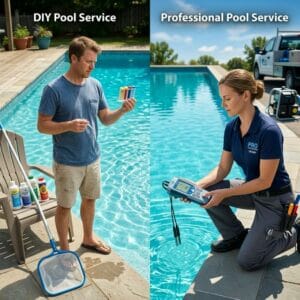
 Every pool owner faces the same question at some point: Do I keep paying someone $140–$180 a month to maintain my pool, or do I learn to do it myself for $30–$40 in chemicals?
I maintained my own pool in Litchfield Park for over a decade, and I’ve also hired professionals during stretches when DIY was impractical due to work or travel.
Both options work — but only if you understand what pool service actually involves, what it should cost, and how to tell whether you or your pool tech is doing it right.
This guide covers the full picture: what weekly pool service includes, how to decide between DIY and professional service, how to find and vet a good pool company, what real pricing looks like in 2026, and the weekly maintenance routine that keeps water clear and equipment healthy regardless of who does the work.
Compare DIY Pool Service to Professional Service
The decision between DIY and hiring comes down to three things: your available time, your comfort with basic chemistry, and how much you value the money saved. Neither choice is wrong — but the math is clear.
| Factor | DIY Pool Service | Professional Service |
|---|---|---|
| Monthly cost | $30–$50 (chemicals only) | $140–$180 (chemicals + labor) |
| Annual cost | $360–$600 | $1,680–$2,160 |
| Time per week | 15–25 minutes | 0 minutes (tech handles it) |
| Chemical knowledge required | Basic: FC, pH, CYA, TA, CH (learnable in one afternoon) | None — tech manages chemistry |
| Equipment familiarity | You learn your pump, filter, and plumbing intimately | Tech knows the equipment; you may not |
| Problem detection speed | Immediate — you see issues as they develop | Weekly at best — problems can worsen between visits |
| Emergency response (monsoon, algae bloom) | You handle it the same day | Wait for next scheduled visit or pay emergency fee ($75–$150) |
| Annual savings vs. professional | $1,200–$1,600 | N/A |
The DIY approach requires about 20 minutes a week once you have a routine established. That’s roughly 17 hours a year to save $1,200–$1,600, which works out to $70–$95 per hour of your time. Most people who try DIY pool service for a month never go back to paying a pro. The learning curve is real but short: after 3–4 weeks of testing and adjusting, the routine becomes automatic.
Before you call a professional pool service, understand exactly what you’re paying for. A service tech performs the same 15–20 minute routine described in this guide — test the water, add chemicals, empty baskets, brush surfaces, check the filter pressure. The most cost-effective remediation is learning to do these steps yourself, because the chemicals cost the same whether you buy them or the tech does. Saving money on service visits requires you to handle basic troubleshoot pool problems tasks that professionals usually charge $100+ for.
Evaluate What Weekly Pool Service Actually Includes
Whether you do it yourself or hire someone, proper weekly pool service follows the same steps in the same order. Skipping any of these — or doing them out of sequence — creates problems that compound over time.
| Service Step | What It Does | Tool / Product | Time | Frequency |
|---|---|---|---|---|
| Test water chemistry | Measures FC, pH, TA — determines what chemicals to add | Liquid drop test kit (Taylor K-2006 or equivalent) | 3–5 min | Weekly (minimum) |
| Add sanitizer | Maintains free chlorine at 2–4 ppm to kill bacteria and algae | Liquid chlorine (sodium hypochlorite, 10–12.5%) | 1–2 min | Weekly or as needed |
| Adjust pH | Keeps pH at 7.4–7.6 to prevent scaling and corrosion | Muriatic acid (31.45% HCl) | 1–2 min | As needed after testing |
| Empty skimmer and pump baskets | Removes debris blocking the flow to the filter | Hands (or garden hose to rinse) | 2–3 min | Weekly (more often during the monsoon) |
| Brush walls and waterline | Disrupts biofilm and algae attachment in low-circulation zones | 18-inch nylon or stainless steel pool brush | 5–8 min | Weekly |
| Check the filter pressure gauge | Detects filter media saturation — clean when 8–10 PSI above baseline | Built-in pressure gauge on the filter tank | 30 sec | Weekly |
| Inspect the pump and the equipment pad | Catches leaks, unusual noise, or corrosion early | Visual and auditory inspection | 1–2 min | Weekly |
The entire routine takes 15–25 minutes, depending on pool size and condition. I do mine every Saturday morning before the Arizona heat kicks in. The order matters: test first, then add chemicals based on the results, then physical cleaning. Adding chlorine before testing is the most common mistake both DIY owners and lazy service techs make — you end up over-dosing or under-dosing because you’re guessing instead of measuring.
Vet a Pool Service Company Before You Hire
If you decide professional service is the right call — maybe you travel frequently, or you simply don’t want to handle muriatic acid — choosing the right company prevents the costly mistakes that poor service causes. I’ve watched neighbors cycle through three or four pool companies in a single year because they didn’t know what to look for upfront.
| Service Type | Description | Monthly Cost (2026) | Pros | Cons |
|---|---|---|---|---|
| Solo owner-operator | One person owns the business and does all the work | $140–$170 | Same tech every week, knows your pool intimately, highest accountability | No backup if sick or on vacation — your pool waits |
| Route management company | Multiple trucks, assigned routes, dispatched techs | $150–$200 | Always sends someone, better digital reporting, parts access | High technician turnover, inconsistent quality between techs |
| Retail-chain service | Pool supply store offering maintenance as an add-on | $130–$160 | Quick parts access, in-store water testing included | The primary goal is to sell the product — watch for unnecessary chemical upsells |
| Chemical-only service | Tech handles testing and chemical dosing only — you brush, vacuum, and empty baskets | $70–$90 | Half the cost of full service, you stay hands-on with the equipment | You still do physical labor; tech won’t catch debris-related issues |
Regardless of which type you choose, verify these three things before signing:
- General liability insurance: Ask for a Certificate of Insurance (COI). This covers damage to your property — a dropped acid bucket on travertine, a flooded yard from a hose left running, or equipment damaged during service. Any legitimate company can provide this upon request.
- Written service checklist: The company should tell you exactly what’s included in each visit: water test, chemical adjustment, basket clearing, surface brushing, and filter pressure check. If they can’t list specific tasks, the service is undefined and unaccountable.
- Chemical transparency: Ask what sanitizer they use and whether chemicals are included in the monthly rate or billed separately. Some companies charge $140/month, plus $30–$50/month in chemical surcharges, which appear on a separate invoice. Get the all-in number before you commit.
Detect Poor Service Before It Damages Your Pool
The pool industry has a term for bad service: “splash and dash.” A tech arrives, spends 5–8 minutes on your property, dumps chlorine into the pool without testing first, and leaves before the gate finishes closing. You’re paying $150/month for a service that’s doing maybe $15 worth of work per visit. Here’s how to catch it.
- The basket test: Check your skimmer basket the day after your service visit. If it’s full of debris, the tech didn’t empty it. A tech who skips basket clearing isn’t checking the pump basket either — which means restricted flow is wearing out your pump motor between visits.
- The pressure gauge test: Note your filter pressure before and after the tech visits. If you’re paying for a backwash or filter clean and the pressure reading hasn’t changed, the work wasn’t done.
- The blue tape test: Place a small piece of painter’s tape on the pump lid, chlorinator cap, or filter multiport valve handle. If the tape is undisturbed after the service visit, the tech didn’t open your equipment to inspect, test, or add chemicals.
- Test your own water: Run your own chemistry test the same day your tech visits. If free chlorine is outside 2–4 ppm or pH is outside 7.2–7.8, the tech either didn’t test or didn’t adjust properly. A $30 liquid drop test kit is your best investment in verifying the service you’re paying for.
Budget for the Real Cost of Pool Ownership
The “$99/month full service” ads are bait. In 2026, with gas, insurance, chemical costs, and drive time, a technician cannot spend 30 quality minutes at your property for that rate. Companies offering $99 pricing make the difference back through chemical surcharges, “conditioner fees” ($50–$80/year for CYA you may not need), and algaecide upsells that are unnecessary in a properly chlorinated pool.
| Cost Category | DIY Annual Cost | Professional Annual Cost | Notes |
|---|---|---|---|
| Liquid chlorine | $150–$250 | Included (or $200–$350 billed separately) | 10–12.5% sodium hypochlorite, $4–$6/gallon |
| Muriatic acid | $40–$80 | Included | 31.45% HCl, $8–$12/gallon |
| CYA (stabilizer) | $15–$30 (once per season) | $50–$80 (often billed as a separate “conditioner fee”) | Only needed when CYA drops below 30 ppm |
| Test kit reagents | $25–$40/year | N/A (tech’s equipment) | Taylor K-2006 refill kit |
| Filter cleaning (2x/year) | $0 (DIY backwash/hose-off) | $75–$125 per cleaning | Labor-intensive; fair for pros to charge |
| Monthly service labor | $0 | $140–$180/month ($1,680–$2,160/year) | The core cost difference |
| Total annual | $360–$600 | $1,900–$2,700 | DIY saves $1,200–$2,100/year |
That $1,200–$2,100 annual savings is real money. Over 10 years of pool ownership, it’s $12,000–$21,000 — enough for a major equipment upgrade, a vacation, or the down payment on a hot tub. I’ve run the numbers on my own pool every year for the last decade, and the actual savings have been $1,400–$1,600 annually once you account for occasional specialty chemicals and replacement parts.
Manage Your Pool Through Arizona’s Toughest Conditions
Living in the desert creates challenges that generic pool advice doesn’t address. Whether you do your own service or hire a company, these Arizona-specific issues require attention that many pool techs from out-of-state franchise operations don’t understand.
- Monsoon dust storms: A haboob can drop enough fine particulate into your pool to overwhelm a filter in a single evening. If your service day is Friday and the storm hits Tuesday, your pool can turn green before the tech arrives. The DIY approach requires you to brush, vacuum, and shock the same night the storm passes — waiting even 24 hours gives algae a foothold. If you use a service, ask whether they offer emergency storm response visits (usually $50–$75 extra) and whether you can call for one.
- Hard water scaling: Arizona tap water averages 250–400 ppm calcium hardness. Over 2–3 years, calcium deposits build on tile, heater elements, and salt cells. A good service company tests calcium hardness at least twice a year and talks to you about partial drain-and-refill cycles every 3–5 years. If your tech has never mentioned calcium, they’re letting your swimming pool heater and equipment corrode in hard water.
- Thermal Sanitization Stress Period: When water temperatures hit 85–95°F from June through September, chlorine consumption doubles or triples. Your service company should automatically increase chlorine dosing during these months — not wait until the pool turns cloudy to react. If you’re DIY, test twice a week during peak summer instead of once.
Inspect Your Equipment Like a Professional
The most valuable part of doing your own pool service isn’t saving money on chemicals — it’s catching equipment problems early. A pump making a new sound, a filter leaking from the tank band, a hairline crack in a suction line — these are things you notice when you’re hands-on every week. A service tech rushing through a 15-minute visit often misses them.
- Pump noise: A high-pitched whine indicates the pump is starving for water — check the skimmer and pump baskets for debris. Following a consistent pool cleaning routine is the best way to prevent equipment failure. Cavitation (air bubbles in the pump housing) damages the impeller and motor bearings over time. Catching it early costs $0; replacing a burned motor costs $300–$600.
- Filter pressure baseline: Write your filter’s clean starting pressure on a piece of tape stuck to the tank — mine is 12 PSI. When the gauge reads 20–22 PSI (8–10 above baseline), the media is saturated and needs cleaning. Ignoring high pressure forces the pump to work harder, shortens motor life, and reduces filtration quality.
- Leak detection (bucket test): Place a bucket of water on the top step of the pool and mark the water levels in both the bucket and the pool. Wait 24 hours. If the pool water drains faster than the bucket, you have a leak—not just evaporation. Arizona evaporation runs 0.25–0.5 inches per day in summer; anything beyond that warrants a professional leak inspection.
- Suction and return flow: Hold your hand over each return jet. A strong, consistent flow means the plumbing is clear. Weak or uneven flow between jets suggests a blockage, a cracked lateral in a sand filter, or a suction leak on the pump intake side. These are problems a service tech should catch — if yours doesn’t mention flow quality, ask about it.
To rebalance the water chemistries after identifying an equipment problem, always fix the hardware first, then test and adjust chemicals. Adding more chlorine to compensate for a failed filter or a leaking pump just wastes money and masks the real issue.
Pool Service Books


Frequently Asked Questions About Pool Service
How much does professional pool service cost per month?
In 2026, expect $140–$180/month for full service, including chemicals, brushing, vacuuming, and water testing. Chemical-only service (tech tests and doses, you do physical cleaning) runs $70–$90/month. Be skeptical of “$99 full service” ads — these typically recoup costs through chemical surcharges, conditioner fees, and repair upsells. Ask for the all-in annual number before signing.
How do I know if my pool tech is actually doing the work?
Run the blue tape test: place a small piece of painter’s tape on the pump lid, filter valve handle, and chlorinator cap before your tech’s visit. If the tape is undisturbed afterward, the equipment wasn’t opened. Also, check your skimmer basket the day after service — if it’s still full, the tech skipped it. Testing your own water chemistry the same day the tech visits is the best verification: FC should be 2–4 ppm and pH should be 7.2–7.8.
My pool guy says I need to drain the pool. How do I verify?
Test your CYA (cyanuric acid) and TDS (total dissolved solids) with your own test kit. If CYA is above 80–100 ppm, chlorine effectiveness drops significantly, and a partial drain is legitimate. If CYA is 30–50 ppm and TDS is under 3,000, you probably don’t need a drain — the tech may be selling a $200–$400 service you can skip.
Should filter cleanings be included in monthly service?
Most companies charge separately for deep filter cleaning—typically $75–$125 per cleaning, performed 2–4 times per year depending on your filter type and bather load. This is a labor-intensive job, and the extra charge is fair. Weekly, include checking the filter pressure gauge and noting when cleaning is needed.
Why does my pool lose chlorine so fast in August?
Arizona water temperatures above 85°F accelerate chlorine consumption by 2–3x compared to spring. UV exposure breaks down unstabilized chlorine within hours. During the Thermal Sanitization Stress Period (June–September), maintain CYA at 40–50 ppm to protect chlorine from UV exposure, dose liquid chlorine in the evening (not in the morning — sunlight destroys it before it can work), and test FC twice per week instead of once. If your service tech isn’t increasing summer dosing, they’re underdosing your pool.
Can I hire someone just for the chemical service?
Yes. Chemical-only service is a great middle ground for DIY owners who want to handle physical cleaning (brushing, vacuuming, baskets) but don’t want to store or handle muriatic acid and bulk chlorine. It typically runs $70–$90/month, about half of full service. You stay hands-on with your equipment while the chemistry is professionally managed.
Is it hard to switch from professional service to DIY?
The transition takes 2–3 weeks of active learning. Start by buying a liquid drop test kit (Taylor K-2006, ~$60) and testing your water the same day as your tech’s last visit — that gives you a baseline. Follow the weekly maintenance routine for a month while reading your test results and learning what each chemical does. After 3–4 weeks, the routine becomes second nature and takes less than 20 minutes per session.
What insurance should my pool company carry?
At a minimum, general liability insurance. This covers property damage during service — a chemical spill on your deck, a flooded yard from an open valve, or equipment broken during maintenance. Request a Certificate of Insurance (COI) annually. Companies that refuse or stall are either uninsured or underinsured, and you’re exposed if something goes wrong on your property.